
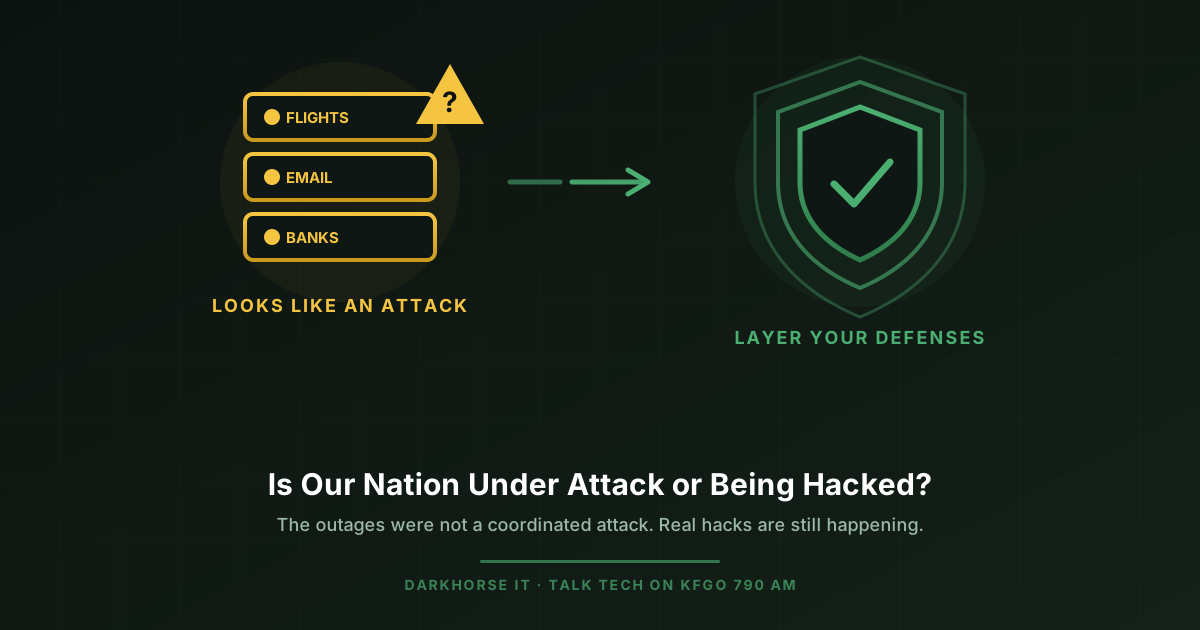
Last week, a lot of big systems went down in a short stretch of days. Microsoft 365 and Outlook had trouble. Flights were grounded nationwide. Bank apps slowed down. Amtrak’s website and app had errors. Apple had an outage, and so did networks at the National Security Agency.
If you watched the news and thought, “Is our nation under attack?” you were not alone. That is a fair question. Here is the official answer, and here is what is actually going on.
Last week’s outages were not a coordinated attack
On November 18, Director of National Intelligence Jay Clayton said these were “separate service outages… not a coordinated or state-sponsored attack.” Secretary of State Marco Rubio put it even more plainly: “We are not under systemic attack.”
That matches what the companies and agencies themselves reported.
Microsoft said a problem with Microsoft 365 and Outlook ran from about 10:20 AM Central on November 12 to about 10:10 AM Central on November 13. Three ordinary problems piled up: a latent gateway bug from July, a shift in Teams traffic, and about 14 percent less gateway capacity. Microsoft called it “a technical issue not related to cyber or AI/agents.” A final report is due November 20. Nobody has claimed it as a hack.
The FAA ordered a nationwide ground stop on November 13, from about 2:30 to 7:15 PM Central. A contractor, L3Harris, deployed a router in a way that flooded the FAA network. Seventeen of 22 centers were affected, and about 12,462 flights were canceled that day. The FAA said there was no indication of a cyberattack, and that it was separate from the Microsoft outage.
Amtrak had website and app errors the same day, from the surge in demand after the ground stop. The trains themselves ran normally, and there was no threat indication.
On November 16, a Chase software bug in hardware Chase runs itself slowed transactions and rippled to Bank of America, Wells Fargo, U.S. Bank, and Zelle. Reporting said the FBI saw no external activity.
Apple’s November 17 outage was caused by an internal update, not an attack. The same day, the NSA said maintenance and a patch issue took down internal networks, with no attack indicated.
There has been no confirmed hack of airlines, the FAA, or Amtrak in this window. The picture that emerges is brittle, centralized technology failing for ordinary reasons, not a single coordinated strike.
Real attacks are still happening
The official word on last week should not lull anyone into thinking the threat is imaginary. Real attacks are underway. Some groups have taken credit. Some incidents have no public claim. Water systems have been tampered with. Iran has been blamed for sabotage in France. And AI tools are being used in actual intrusions.
Attacks where someone took credit
A ransomware group calling itself Storm has, from August into November, claimed attacks on Sawyer Savings, Pioneer Bank, Cecilian Bank, First Secure, Poca Valley, and Insight Credit Union, about $6.7 billion in combined assets. That is a claim. Only Sawyer and Insight have confirmed breaches, and those confirmations include Social Security numbers and IDs being exposed.
A group called BYOD says it hit Vanderbilt University on November 9. Vanderbilt confirmed the attack. The claim that data was stolen is the group’s, not the university’s.
Around November 11, a group called WhiteArmor said it hit Maersk. Maersk confirmed that data was stolen from a legacy system, and the group demanded $5 million. Maersk has not confirmed that WhiteArmor is the group responsible.
In late October, hacktivists calling themselves “Department of Peace,” along with DDoSecrets, went after the Department of Homeland Security. Data on more than 41,000 DHS staff was leaked.
Some other listings on leak sites remain unverified. Qilin listed Telcoe FCU and Via CU in October, and The Gentlemen listed MoneyGram on October 12. A claim on a leak site is not the same thing as a confirmed breach.
Incidents with no public claim
You do not need a group taking credit for an attack to be real.
On November 16, researchers reported a supply-chain skimmer tied to a testing tool from Optimizely. It hit 178 organizations, including well-known names like CNN, BBC, Zoom, HSBC, and IKEA, and it tried to steal card data and crypto wallet addresses. If you shopped or logged in on a major site that week, this is the kind of quiet attack that never looks like a nationwide outage, and still aims at your information.
University Hospitals Cleveland reported a cybersecurity incident on October 22. UNM Health reported one on October 26 that involved ambulance diversion. Neither has a confirmed group behind it.
Around November 16, Infoblox was breached through a SharePoint vendor. That is another reminder that the company you trust can be reached through a vendor you have never heard of.
A worm in a remote-support tool called ScreenConnect was reported around November 13, hitting 288 endpoints across 48 organizations and targeting the technicians who support other businesses.
Water systems have been tampered with
This is not only about banks and websites. On July 30, CISA warned that attackers have been tampering with the industrial controllers that run water and wastewater systems, activity that has led to boil-water notices.
In Clayton County, Georgia, a July 27 pump failure led to a boil-water advisory, with possible cyber activity still under investigation by the FBI and CISA. That one is not a confirmed hack, and it should not be treated as one until investigators say so.
In late August, foreign actors altered settings at two small water utilities in Colorado. Officials said there was no safety impact. The point is not to scare you away from the tap. The point is that real-world infrastructure is being probed and, in some cases, changed.
Sabotage in France
On November 10, France attributed a mid-October attack to Iran’s IRGC-linked Shahid Kaveh group. Between October 11 and 12, refrigeration systems at more than 700 supermarkets were sabotaged, causing fires and tens of millions of euros in losses. That is a state-linked attack on civilian infrastructure, officially blamed, and it is separate from last week’s U.S. outages.
AI is being used in real hacks, not in last week’s outages
No official source has tied last week’s outages to AI. Microsoft has explicitly said they were not.
There is a discussion, including in that Foreign Policy explainer, that AI-driven vulnerability discovery may be forcing rushed patches on older systems. That is a theory about why some technology is under strain. It is not evidence that last week’s outages were an attack.
What is documented is that AI tools are already being used in real intrusions. Microsoft has described an AI framework called ARTEX being used by a China-aligned group known as Storm-0940. A Barracuda cloud intrusion on November 1 and 2 used a leftover key from an AI vendor, with methods matching that same ARTEX framework. The FBI and IC3 issued an advisory on ARTEX on November 13. Researchers also say a Chinese-speaking actor used a jailbroken DeepSeek agent against a European telecom, tied to a Cisco BroadWorks flaw that CISA added to its known-exploited list on November 10.
So the honest split is this: last week’s cluster was everyday technology failing in public. The evidence that we are being hacked sits in the ransomware claims, the unclaimed incidents, the water-system tampering, the attack in France, and these AI-accelerated tools.
What we can do
We cannot prevent a software bug at a major airline vendor or a bank. We can make our own homes and businesses much harder to hurt.
Follow best-practice security. That is not a slogan. It is a short list you can actually do.
Use 3-2-1 backups: three copies of your important files, on two different kinds of storage, with one copy offsite or in the cloud. If ransomware ever hits, a backup you can actually restore is what gets you back to work.
Turn on two-factor authentication on all of your accounts. A password alone is not enough.
Use strong passwords, and use a password manager so you are not recycling the same one everywhere.
Add layers of security so one breach does not compromise everything. That means modern EDR security, which is software that watches your computers for suspicious behavior, and properly configured firewalls. No single tool is enough on its own.
Put IoT and smart devices (TVs, cameras, doorbells, thermostats, and the like) on a guest network, separate from your computers and phones. If a gadget is compromised, it should not have a straight path to your files and accounts.
Consider using AI to audit your infrastructure. The same kind of technology being used to find holes can also help you find yours before someone else does.
If you run a website or business email, you can also use DarkHorse IT’s free domain and email security checker. It checks your domain and email setup, not the devices in your house.
Last week’s outages were not a coordinated national attack. The hacks that are real are quieter than a nationwide ground stop, and they are not waiting for a dramatic headline. Do the basics, stack your layers, and you are already ahead of most of the opportunistic attacks.
Join us Thursdays at 7:40 AM on KFGO 790 AM.